
UPDATE: September 9, 2026
CPA is now available to all MTP employees. Updates and improvements since our initial release include:
- Quicker response times: We upgraded the underlying AI intelligence engine, meaning answers to intricate performance questions now generate noticeably faster.
- Full conversation memory: CPA now remembers everything discussed in a session. For example, ask a broad question about Q2 performance, then drill into specifics (like a particular campaign, platform, or date range) without needing to re-explain previous context or constraints.
- Light/dark mode
Your clients’ marketing data has been trying to tell you something for months. We finally built something that listens.
Let me tell you about a problem we’ve watched happen dozens of times. A strategist pulls up last week’s campaign report. It’s a wall of numbers. Impressions here, conversions there, three tabs of Facebook data, two sheets of Google, and a creative deck someone emailed over as a PDF on Tuesday. The strategist is sharp. They know what they’re looking for. But by the time they’ve cross-referenced the right rows, the insight is an hour old and the client meeting is in twenty minutes.
That’s not an analyst problem. That’s an infrastructure problem. And infrastructure problems are what we do.
Behind every client account, there’s a team of data analysts doing the unglamorous, essential work of pulling raw platform data together, normalizing it, and building it into something coherent. That work doesn’t go away, it’s the foundation. What’s been missing is what happens after it. Once the data is clean, structured, and sitting where it needs to be, there’s still a gap between “the data exists” and “someone understood it in time to act on it.”
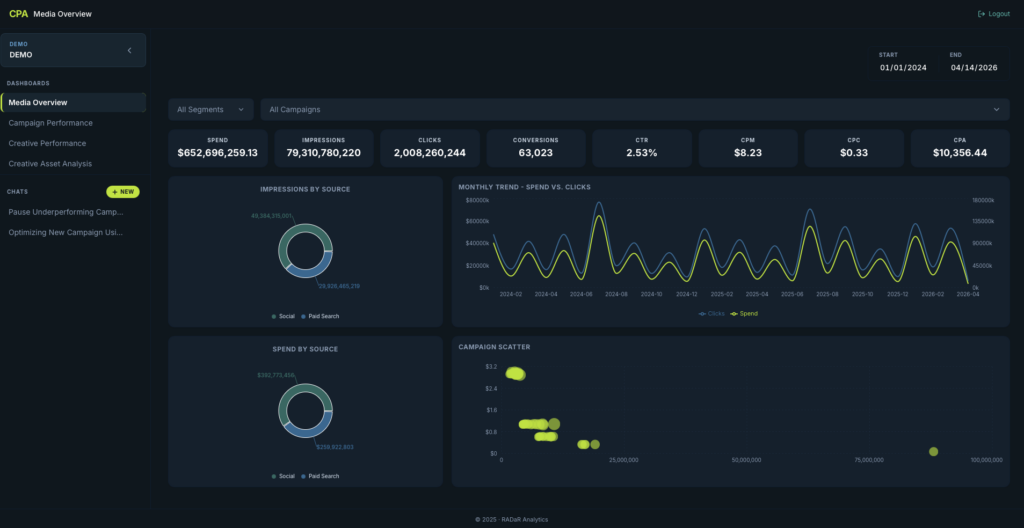
Today, we’re launching Campaign Performance Assistant (CPA): an AI-powered analysis tool built on top of that foundation. It brings paid media performance data, creative metadata, and natural language interaction into a single, unified interface. Drill into segments. Review charts. Cross-reference channels. Ask it a question in plain English and get an answer grounded in your actual data. No pivot tables required.
The problem wasn’t too little data. It was too much, in too many places.
Export from BigQuery, cross-reference with Facebook, manually match creative files, and eventually synthesize it all in a deck. Each step was a place where context could get lost, timing could slip, and frankly, the person doing the analysis needed to be a power user just to get started.
The data was always there. The problem was what happened after it was ready. Performance on one side, creative assets on the other, a dashboard built for overview, and a human being doing the translation work every time someone needed to go deeper.
“The insight was always in the data. Getting there just required the right question at the right time.”
CPA is our answer to that gap. It doesn’t replace the dashboards or the analysts who build them, it extends them. It’s a conversational layer on top of structured, clean data that lets anyone on the team interrogate that data in plain English, slice it by segment, and get to an answer without filing a request or opening a spreadsheet.
What’s actually under the hood (the short version)
We deliberately didn’t build this on vibes and a shortcut. The data architecture matters, so here’s the honest version of how it works, without the buzzword bingo.
Performance data flows in from Google BigQuery, where ad platform metrics from Google, Meta, TikTok, and others are already being aggregated by the analyst team. That data lands in Snowflake, our data warehouse, where it gets normalized, deduplicated, and organized per client. Every client gets their own schema. Their data doesn’t touch anyone else’s.
Creative assets live alongside that performance data, linked by the same identifier the ad platform used to report on them. That connection (between what ran and how it performed) is what makes the analysis meaningful rather than just fast.
The result is a unified data model where a question like “which creatives drove the strongest conversion rate on Meta last month?” isn’t a three-step manual process anymore. It’s a conversation with a system that already knows how to answer it.
What you can actually do with it
Here’s what daily use looks like in practice. A strategist selects their client’s workspace: a self-contained environment with that client’s full data history, platform connections, and any campaign context the team has added to orient the analysis. From there, it’s a conversation.
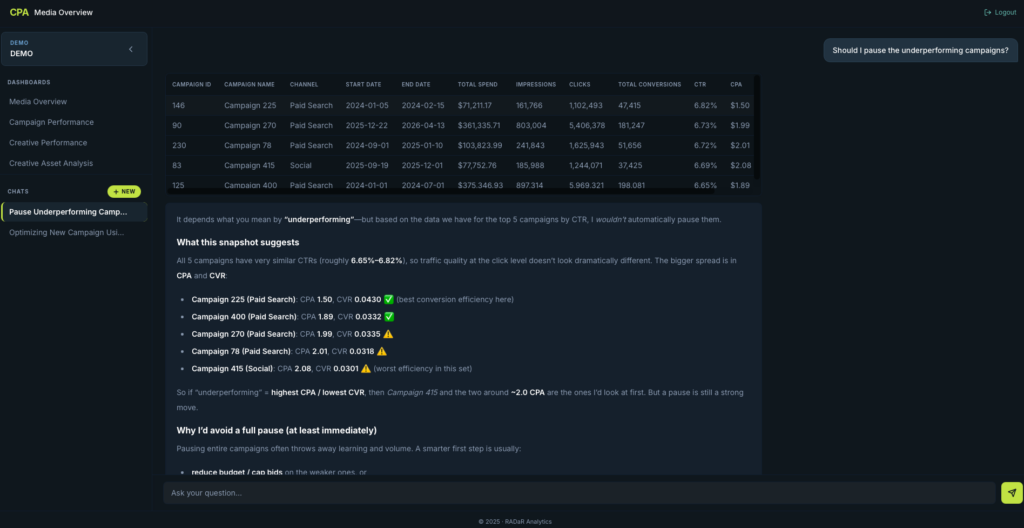
Ask which campaigns are underperforming against their benchmarks. Ask what the highest-CTR creative looked like across a given time window. Ask for a plain-English summary of last quarter’s Facebook performance. Ask whether video drove better engagement than static in the Awareness tier. CPA pulls from the underlying data, reasons over it, and responds. And if you need to drill further, you just keep asking.
The answer might be a number, a trend, or a chart; and when it’s relevant, the creative asset itself, right alongside the metrics it generated. The goal isn’t just faster answers. It’s walking into a client meeting already knowing what the data says, with the work done before the conversation starts.
Who’s it for?
Right now, CPA is an internal tool built for strategy, account, creative, media, and data teams across the MTP agency network. It’s not client-facing, and that’s intentional. We want to use it to generate better work for clients, not hand them a tool and call it a deliverable.
Why we built it the way we did
There’s a version of this product that’s simpler: a dashboard with some filters and a chatbot bolted on. We didn’t build that version because we’ve seen how it ages. You get eighteen months in and realize the “AI layer” is just keyword matching over a canned report template, and the data underneath is still a mess of duplicated rows and manually reconciled channel names.
We built CPA on a data model that’s designed to flex. New channels, new segmentation dimensions, new ways of slicing performance data — and none of those require rebuilding the foundation. The system was designed for a world where the question you’re asking next year is one we haven’t thought of yet.
CPA is also built in distinct layers rather than one tangled system. That means when the AI gets better (and it does, constantly) we can upgrade the parts that need upgrading without touching the parts that don’t. The architecture earns its keep by staying out of the way.
What comes next
Version 1.0 launches June 1st, 2026, and the scope is deliberately focused. We’re not trying to do everything on day one. We’re trying to do the core use case exceptionally well. Natural language analysis of multi-platform performance data, with creative context, organized by client. That’s one point zero.
From there, the roadmap gets more interesting: richer visualization inside the interface, deeper cross-client pattern recognition, and tighter integration with the broader Intelligence Platform and Campaign Intelligence that CPA is part of. The infrastructure we’ve built supports all of that without needing to be redesigned.
The short version: This is not a prototype. It’s a foundation.
If you’re a part of Meet The People and want to know more about what Campaign Performance Assistant can do for your client accounts, or if you want to be part of the early internal rollout, reach out to [email protected]. We built this to be used, and the best way to make it better is to put it in front of the people who need it most.
The data has been trying to tell you something. Now you have something to ask.
@Candice Rotter kudos on the launch!